
SERIES / The Mathematics of Musical Pitch · Article 01
What Is a Musical Interval? Ratios, Tuning, and Consonance
Frequency ratios, musical intervals, and the limits of consonance.
ABSTRACT
This opening article explains what a musical interval is before asking why some intervals have seemed especially important in the history of music. It defines sound, frequency, pitch, and interval in accessible terms; uses an ideal string to derive the octave, fifth, and fourth; introduces ancient Greek harmonic theory and the later history of tuning; and shows why ratios survive transposition while frequency differences do not. It ends by separating exact interval mathematics from the more difficult perceptual question of consonance.
- Published
- Updated
- Reading time
- 14 min
- Author
- Natoandro
VERSION HISTORY 1 archived version
Play 220 Hz and then 330 Hz. Now play 440 Hz and then 660 Hz. The second pair is separated by twice as many hertz as the first, yet both pairs trace the same musical motion: each rises by a perfect fifth.
Why? The answer is not the size of the frequency gap. It is the ratio:
This article begins with that small calculation and develops it slowly. Along the way, we will define the words that musicians use casually but mathematicians must make precise: sound, frequency, pitch, interval, octave, fifth, pure, and consonance.
The central claim is modest but powerful:
In tuning mathematics, an interval is a relationship between frequencies, and that relationship is multiplicative.
This is not yet a theory of why every listener likes one sound more than another. It is the mathematical starting point from which tuning systems, harmonic spectra, and later theories of consonance can be studied.
First: what is a sound?
A sound is a physical disturbance that travels through a medium such as air. A loudspeaker, string, vocal fold, or drum does not send “music” through the air as an abstract object. It creates changing pressure. The pressure rises and falls as the source vibrates, and those changes propagate outward as a wave.
For a repeating vibration, two quantities are especially useful:
- Period, written , is the time required for one complete cycle.
- Frequency, written , is the number of cycles per second.
They are reciprocals:
The unit of frequency is the hertz, abbreviated Hz. One hertz means one cycle per second. A vibration at 220 Hz completes 220 cycles each second. A vibration at 440 Hz completes twice as many. Introductory musical-acoustics treatments use these quantities to connect physical vibration with the sounds produced by strings, pipes, and other instruments.
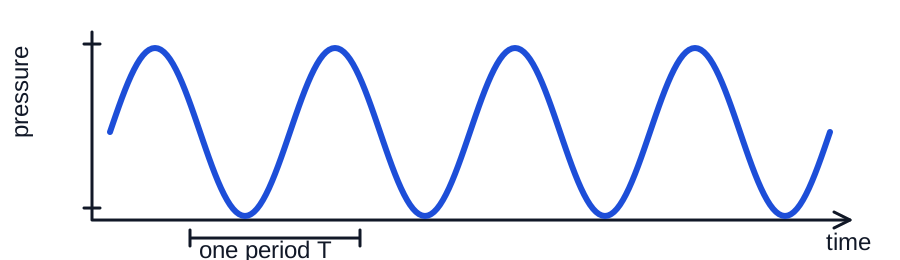
The waveform above is deliberately simple. Real instruments rarely produce a perfect sine wave. They produce a fundamental vibration together with additional components called partials. When those partials occur at integer multiples of the lowest frequency, they are called harmonics.
Frequency is not the same as pitch
Frequency is a measurable physical quantity. Pitch is the auditory attribute by which a listener hears a sound as relatively high or low. For many steady, pitched sounds, higher fundamental frequency tends to be heard as higher pitch. But pitch is not simply a second name for frequency. It is a perceptual response to a sound, and the spectrum, duration, loudness, and context can influence it.
This distinction matters throughout the article:
- when we write , we are describing a physical frequency;
- when we say “the note is higher,” we are using a musical and perceptual description;
- when we define an interval as a ratio, we are building a mathematical model of the relationship between two frequencies.
The model is powerful because it captures an important regularity without claiming to explain every detail of hearing.
What is a musical interval?
An interval is the relationship between two pitches. In everyday music theory, intervals can be named with words such as unison, second, third, fourth, fifth, sixth, seventh, and octave. Those names combine two ideas that should be separated at first:
- a qualitative or notational name, often based on staff positions and note letters;
- a quantitative size, which can be represented by a frequency relationship.
For two positive frequencies and , define the directed frequency ratio from the first to the second as
The word directed means that order matters. Going from 220 Hz to 330 Hz gives . Going back gives :
A unison, in which both sounds have the same frequency, has ratio . A modern mathematical treatment of tuning uses this frequency-ratio definition and identifies the pure octave, fifth, and fourth with , , and .
Three terms that are easy to confuse
- Interval: the relationship between two pitches.
- Ratio: the quotient that represents that relationship in a frequency model.
- Difference: the subtraction , measured in hertz.
A difference is useful when discussing physical spacing in frequency. It is not stable under transposition, so it cannot by itself represent interval identity.
A string turns geometry into pitch
The simplest route from a physical object to a frequency ratio is an ideal string fixed at both ends. Imagine a string with:
- vibrating length ;
- tension ;
- linear mass density , meaning mass per unit length.
For the idealized fundamental mode, the frequency is
This formula is the standard ideal-string starting point in musical acoustics.
This is a model, not a complete description of a piano, guitar, or violin. Real strings have stiffness, their supports move slightly, and the instrument body changes the sound that reaches the listener. A peer-reviewed analysis of guitar-string mechanics begins with the same one-dimensional wave-equation relationship before adding the effects of bending and fretting.
If tension and linear density remain fixed, the square-root factor is constant. Therefore
The symbol means “is proportional to.” Here it says that if the vibrating length is multiplied by a factor, the frequency is multiplied by the reciprocal factor.
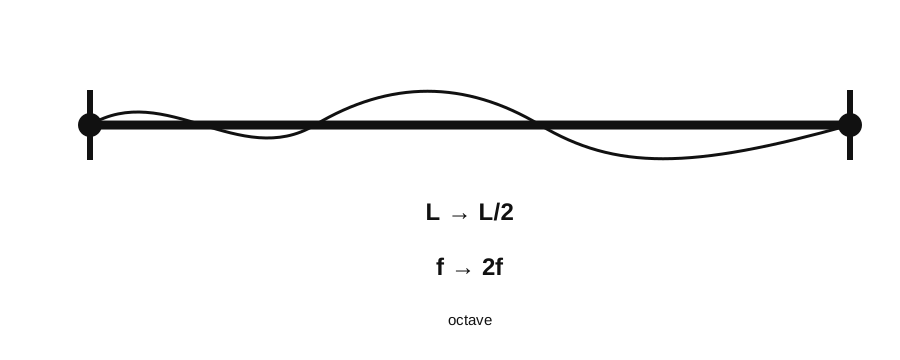
- Halve the length, and the frequency doubles.
- Multiply the length by , and the frequency is multiplied by .
- Multiply the length by , and the frequency is multiplied by .

Now shorten the active length from to :
The frequency doubles. In the ratio model, the interval from to is an octave.
Shorten the string to :
The interval is a perfect fifth in the pure-ratio sense.
Shorten it to :
The interval is a perfect fourth.
| Interval | Frequency multiplier | Required ideal-string length |
|---|---|---|
| unison | ||
| octave | ||
| perfect fifth | ||
| perfect fourth |
The adjectives need care. Pure means that we are using an exact ratio in the model. It does not mean that every instrument, tuning system, or performance uses exactly that value. Equal temperament deliberately changes most intervals slightly so that music can modulate between keys without accumulating the same kind of tuning problem found in pure fifth construction.
A short history of number and music
The connection between number and musical interval is ancient, but the popular story needs qualification. A familiar version says that Pythagoras discovered the octave, fifth, and fourth by comparing simple lengths on a monochord. The surviving history is more complicated than that single anecdote.
Ancient Greek theorists wrote about harmonic divisions, intervals, and numerical relationships, but they did not all share one theory or one method. Modern historians distinguish the surviving theoretical texts from later stories that attribute a unified discovery to Pythagoras.
A monochord is a one-string measuring instrument. A movable bridge changes the length of the vibrating section, allowing a theorist to compare lengths and sounds. In the ideal-string model, length ratios become frequency ratios in the opposite direction:
The instrument therefore makes a geometric relationship audible. That does not prove that ancient musicians all used the same tuning, nor does it show that a simple ratio automatically produces a universal emotional response. It shows why ratios were attractive mathematical descriptions of certain interval relationships.
From Pythagorean tuning to temperaments
A tuning system is a rule for assigning frequencies to the notes used by a musical tradition or instrument. Pythagorean tuning constructs pitch relationships mainly from pure fifths and octaves. Starting from a reference frequency, one can multiply by to move up a fifth and multiply or divide by to move the result into a chosen octave. Historical surveys describe this construction alongside later systems such as meantone, well temperament, and equal temperament.
The mathematical problem is that pure fifths and octaves do not fit together perfectly. Twelve pure fifths come close to seven octaves but do not equal them. The small discrepancy is the Pythagorean comma. The modern literature on Pythagorean-like tuning describes this construction through repeated fifths, fourths, and octave adjustment. Article 2 develops the elementary arithmetic behind the mismatch; the later logarithmic treatment will measure the same relationship as an additive distance.
A temperament is a family of strategies for managing such discrepancies. Instead of preserving every pure ratio exactly, a temperament distributes or concentrates the errors so that an instrument can support a practical collection of notes. Equal temperament divides the octave into twelve equal logarithmic steps. It is one solution to a tuning problem, not the definition of music itself.
Intervals multiply
The ratio definition makes interval composition almost automatic. Suppose three frequencies satisfy . Then
The middle frequency cancels. This is the algebra of consecutive melodic movement.
Go up a pure fifth and then a pure fourth:
The result is an octave.
Go up a pure fifth and then down a pure fifth:
The result is unison.
This multiplicative behavior is why ratios are more than a convenient notation. They preserve the way interval movements combine.
Why differences fail
Suppose interval size were described by the frequency difference .
- From 220 Hz to 330 Hz, the difference is 110 Hz.
- From 440 Hz to 660 Hz, the difference is 220 Hz.
But both are the same proportional move, a pure fifth. The difference doubles when the entire pair is moved up by an octave.
Ratios do not change under common scaling. If , then
This is transposition in the mathematical sense used here: moving a relationship to another register while preserving its ratio. A pure fifth above 220 Hz is 330 Hz. A pure fifth above 440 Hz is 660 Hz. The absolute gap changes, but the multiplicative relationship remains .

The first integer patterns
The small integers in , , and are not decoration. They describe how repeated interval operations interact.
Two octaves multiply to
so , , and form successive octaves.
Two fifths produce
This lies above one octave. Dividing by moves it into the octave from to :
The result, , is the Pythagorean whole tone. This example shows how a tuning system can generate a family of intervals from a small set of multiplicative operations.
A useful mathematical question now appears:
If positive integers and solved this equation, repeated pure fifths could close exactly against octaves. But the equation would imply
which is impossible because a positive power of cannot equal a positive power of . Article 2 turns this observation into the full Pythagorean-comma proof; Article 3 then revisits the ratio through logarithms and rational approximation.
Ratio is not the same as consonance
At this point it is tempting to say: “Small integer ratios sound consonant.” That sentence compresses several different claims into one.
A ratio such as is an exact mathematical relationship. Consonance is a judgment about a sound or combination of sounds. It can depend on:
- the partials present in each tone;
- whether those partials are harmonic or inharmonic;
- the frequency separation between nearby components;
- beating and roughness;
- the auditory system’s critical bands;
- register, loudness, onset, and duration;
- timbre, meaning the spectral character of a sound;
- musical experience and cultural context.
Historical acoustics treated partial tones and beating as central to the explanation of consonance. Helmholtz’s nineteenth-century account is important in that history, but it should be read as a historical theory rather than as the final word on perception.
Later psychoacoustic work connected tonal consonance with interactions among partials and the auditory critical-band framework. This helps explain why nearby components can produce roughness, but it still does not turn a frequency ratio into a complete perceptual law.
The distinction becomes even clearer across listeners and timbres. One study reported cross-cultural variation in responses to consonance and dissonance. Another found that consonance preferences could be reshaped by changing the spectral character of the sounds. A mathematical interval and a listener’s response are related subjects, not identical facts.
One useful way to keep the claims separate is:
- What is the mathematical interval? In this article’s model, it is a frequency ratio.
- What is in the sound? A real tone may contain a fundamental and many partials.
- How is the combination perceived? That is an empirical question involving acoustics, auditory processing, timbre, experience, and culture.
The relationship between tuning and timbre is itself a substantial subject. Sethares shows why changing a sound’s spectrum can change which scales and intervals seem to fit it well.
What this article establishes
We can now answer the narrower mathematical question precisely.
- A sound is a physical disturbance propagated through a medium.
- Frequency counts cycles per second, while period measures the duration of one cycle.
- Pitch is a perceptual attribute related to, but not identical with, physical frequency.
- An interval can be represented by the directed ratio .
- A string model explains why shortening a vibrating length raises frequency.
- The pure octave, fifth, and fourth correspond to , , and .
- Consecutive intervals multiply, and reversing an interval takes its reciprocal.
- Ratios survive common scaling, while frequency differences do not.
- Ancient and later tuning traditions used, modified, and debated these relationships.
- Consonance cannot be reduced to a ratio alone.
These conclusions combine physical acoustics, tuning theory, historical scholarship, and psychoacoustic research rather than following from one source alone. [, , , , , , , , ]
The compact mathematical starting point is therefore
That equation does not explain every reason two notes may sound related. It does something more foundational: it gives us a stable object whose composition, inversion, transposition, and failure to close can be studied. The next article follows the failure to close and shows how a familiar musical problem becomes a theorem in elementary number theory. The following logarithmic-pitch article changes coordinates again, measuring the comma in cents and comparing equal divisions of the octave.
Notation and prerequisites
- Frequencies , , and are positive and measured in hertz unless stated otherwise.
- is vibrating length, and is linear mass density.
- A pure interval is an exact ratio in the mathematical model. It is not a claim that every practical tuning uses that exact ratio.
- Only elementary algebra is required here. Later articles will introduce logarithms and elementary number theory when they are first needed.
Bibliography
- Neville H. Fletcher, Thomas D. Rossing, The Physics of Musical Instruments. 1998. doi:10.1007/978-0-387-21603-4
- Götz Kersting, The Mathematical Structure of Pythagorean-like Tuning Systems. 2025. doi:10.1007/s00283-025-10478-y
- David Robert Grimes, String Theory - The Physics of String-Bending and Other Electric Guitar Techniques. 2014. doi:10.1371/journal.pone.0102088
- J. Murray Barbour, Tuning and Temperament: A Historical Survey. 1951. Source
- Andrew Barker, Greek Musical Writings, Volume 2: Harmonic and Acoustic Theory. 1989. doi:10.1017/CBO9780511552776
- Thomas J. Mathiesen, Apollo's Lyre: Greek Music and Music Theory in Antiquity. 1999. Source
- Dave Benson, Music: A Mathematical Offering. 2006. Source
- Hermann von Helmholtz, On the Sensations of Tone as a Physiological Basis for the Theory of Music. 1885. Source
- Reinier Plomp, Willem J. M. Levelt, Tonal Consonance and Critical Bandwidth. 1965. doi:10.1121/1.1909741
- Josh H. McDermott, Alan F. Schultz, Eduardo A. Undurraga, Ricardo A. Godoy, Indifference to Dissonance in Native Amazonians Reveals Cultural Variation in Music Perception. 2016. doi:10.1038/nature18635
- Raja Marjieh, Peter M. C. Harrison, Harin Lee, Fotini Deligiannaki, Nori Jacoby, Timbral effects on consonance disentangle psychoacoustic mechanisms and suggest perceptual origins for musical scales. 2024. doi:10.1038/s41467-024-45812-z
- William A. Sethares, Tuning, Timbre, Spectrum, Scale. 2005. doi:10.1007/978-1-84628-605-0