
SERIES / The Mathematics of Musical Pitch · Article 03
Why Is Pitch Logarithmic? From Frequencies to the Geometry of Pitch
From frequency ratios to pitch space.
ABSTRACT
Musical intervals multiply frequencies, but musicians often describe them as distances: semitones, cents, and octaves. This article introduces p = log_2(f/f_0) as a coordinate that reconciles those descriptions. It shows why an octave is one unit, why cents are logarithmic rather than linear hertz, how rational approximation produces equal temperament, and how octave equivalence turns pitch space into the circle R/Z. The logarithm does not make pitch identical to frequency or explain perception; it provides a useful mathematical geometry for interval relationships.
- Published
- Updated
- Reading time
- 14 min
- Author
- Natoandro
VERSION HISTORY 1 archived version
The previous article left us with a mismatch:
Twelve pure fifths are a little more than seven octaves. The ratio calculation tells us how much the endpoints differ, but it does not yet give us a convenient ruler for comparing that difference with other intervals.
The next step is a change of coordinates. Define the logarithmic pitch coordinate
where is a frequency and is an arbitrary reference frequency. Changing shifts every coordinate by the same constant, so it does not change interval distances. The choice of base 2 is deliberate: the octave is multiplication by 2. In this coordinate, multiplication by 2 becomes addition by 1.
There is also an empirical reason to care about this coordinate. In transposition experiments, Attneave and Olson found that the musical scale preserved the relationships listeners used to recognize transformed pitch patterns better than the mel scale over the ordinary musical range. Their result does not prove that musical pitch is mathematically logarithmic in every context, but it motivates asking which transformations a useful pitch representation should preserve.
The central question is:
How can multiplicative frequency relationships become additive distances that we can compare and compose?
Ratios become distances
Suppose two frequencies have ratio . Their logarithmic separation is
This is the key identity. The ratio remains the underlying musical relationship; the logarithm supplies an additive coordinate for it. A pure fifth, whose ratio is , has logarithmic size
That is why a diagram of fifths can treat each fifth as the same fraction of an octave. Baez uses exactly this interpretation when describing each multiplication by as moving by around the octave circle.
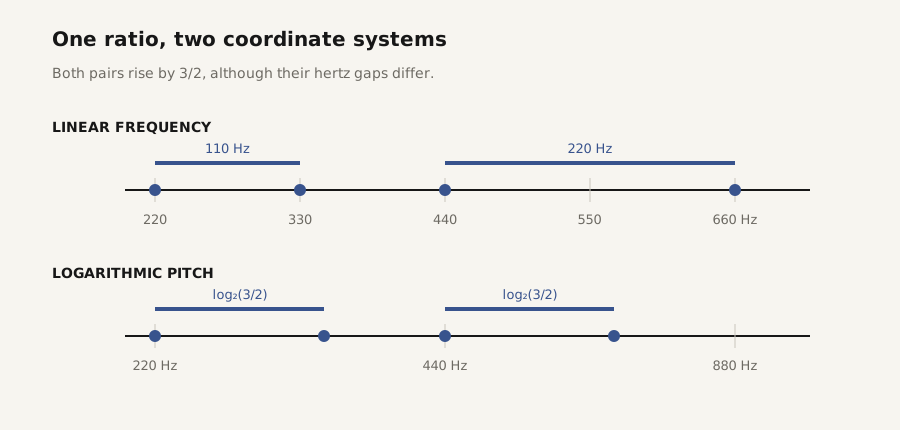
Composition now becomes ordinary addition. If an interval has ratio and a second interval has ratio , the combined ratio is , while its logarithmic size is
The algebra has changed appearance, not content. In ratio coordinates, intervals multiply. In logarithmic coordinates, the same intervals add.
The octave is one unit
An octave takes to . Therefore
Every octave has the same length in this coordinate, regardless of register. The move from 220 Hz to 440 Hz and the move from 440 Hz to 880 Hz are both one logarithmic unit, even though their differences are 220 Hz and 440 Hz.
This is the logarithmic version of transposition. If both frequencies are multiplied by the same positive number , then
The common factor cancels. A ratio and its logarithmic distance therefore preserve the interval when a pair is moved to another register. This is the same invariance that made ratios more useful than hertz differences in the opening article.
Cents: a smaller ruler
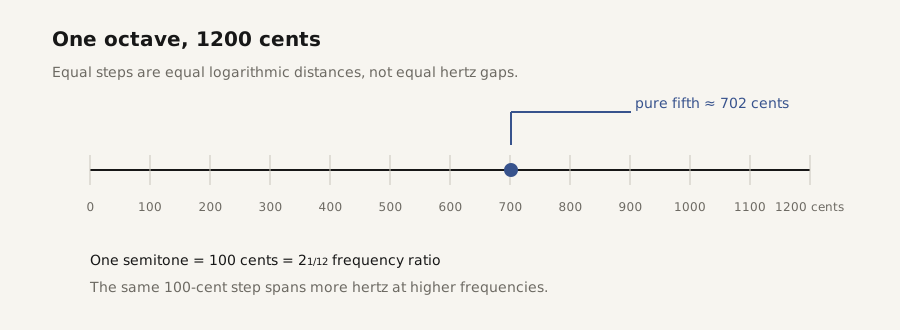
One octave contains 1200 cents by convention. Since one octave is one logarithmic unit, the size of a ratio in cents is
The formula is useful because it makes small discrepancies readable. The Pythagorean comma has ratio , and its logarithmic size is approximately 23.5 cents.
Notice what cents are not. They are not a linear number of hertz. One hundred cents always means one twelfth of an octave, but the corresponding hertz difference depends on the register. At a reference frequency , an interval of cents multiplies frequency by
For example, 100 cents multiplies frequency by . At 220 Hz this is about 13.9 Hz; at 440 Hz it is about 27.7 Hz. The same musical distance has a different absolute frequency gap because pitch relationships are multiplicative.
The logarithm thus gives us two equivalent descriptions:
- ratio language: an interval multiplies frequency by ;
- distance language: the same interval has size octaves or cents.
Neither description is more physically real than the other. The ratio describes the frequency relationship; the logarithmic scale is a coordinate system chosen because it respects octave structure.
Equal steps are multiplicative
Suppose an octave is divided into equal steps. Each step must have the same ratio , and steps must multiply to 2:
Taking logarithms gives , so
For twelve equal steps, the semitone ratio is . The logarithmic comparison makes the definition transparent: the octave is divided into twelve equal distances, not the frequency interval from 1 to 2 divided into twelve equal hertz gaps. We can now compare the pure fifth with this step grid and ask why twelve steps are useful.
This also explains why “equal” needs a qualifier. Equal temperament makes steps equal in logarithmic pitch, while their frequency differences grow with register.
The fifth as a rational approximation
The pure fifth has logarithmic size
octaves. In twelve equal steps, the nearest simple description is seven steps, or octaves. The difference is
Thus the equal-tempered fifth is 700 cents, about 1.955 cents narrower than the pure fifth at approximately 701.955 cents. Across twelve fifths, that small error adds to approximately cents, the logarithmic size of the Pythagorean comma in the opposite direction. Equal temperament closes the cycle by distributing the discrepancy rather than preserving every fifth exactly.
This is a rational-approximation problem. We seek a fraction close to , because equal-tempered steps out of an octave of steps should approximate a pure fifth. The denominator is not forced by the logarithm alone; it is a design choice that gives a useful compromise among range, notation, and interval errors. The mathematical question is therefore not “why is twelve the one true number?” but “what errors result when a system chooses twelve equal divisions?”
Other equal divisions illustrate the tradeoff:
| Equal division | Fifth approximation | Fifth size | Error from pure fifth |
|---|---|---|---|
| 12-TET | 700.000 cents | cents | |
| 19-TET | 694.737 cents | cents | |
| 31-TET | 696.774 cents | cents | |
| 53-TET | 701.887 cents | cents |
The table does not establish that 53 equal steps are musically preferable. It shows only that increasing the number of available steps can improve the approximation to this one interval while making the system more complex in other ways. Equal temperament is a family of compromises, not a single inevitable scale.
Octave equivalence and the pitch-class circle
So far, distinguishes every octave. But musical notation often treats frequencies related by octaves as versions of the same pitch. If for an integer , then
The two logarithmic coordinates differ by an integer. If we declare such differences irrelevant, we identify and . The resulting pitch class is represented by
Geometrically, this is a line whose endpoints are glued together: moving one octave reaches the same point. Baez describes the equivalent frequency construction by saying that two tones have the same pitch class exactly when their frequencies differ by a power of 2.
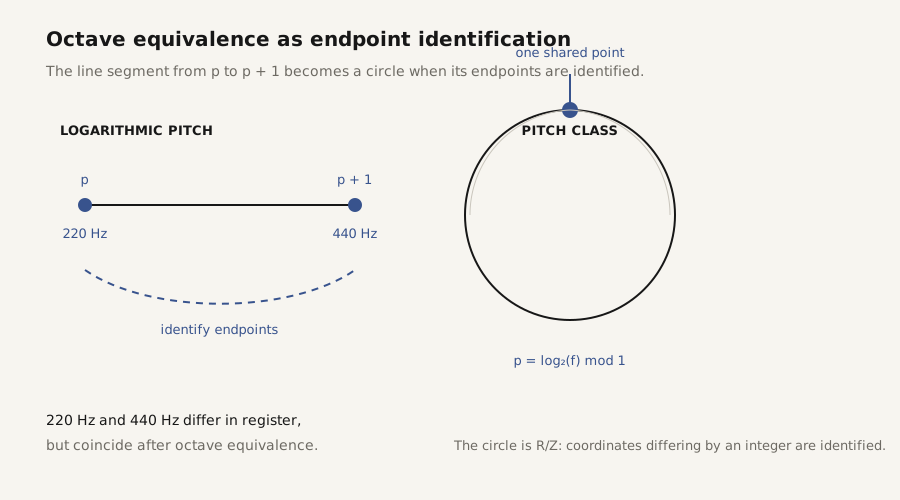
The circle is therefore not a claim that all frequencies are the same. It is a quotient: we deliberately forget the integer that records how many octaves separate two representatives. The pitch class of 220 Hz and the pitch class of 440 Hz coincide in this model, while their absolute frequencies remain different.
As the opening article emphasized, a pitch class is not a frequency and is not a complete perceptual description of a note. Here it is an abstraction that preserves octave-relative position while discarding register.
That limitation is not merely philosophical. Stevens, Volkmann, and Newman measured a subjective pitch scale and reported that it differs from both the musical scale and the frequency scale. Their result belongs to psychophysics, not to the algebra developed here, but it is a useful warning against treating as a complete model of perception.
Their later revised scale also reported that octave and fifth intervals became subjectively larger as frequency increased over the tested range. This is an important qualification: the logarithm is exact for the mathematical interval model, whereas perceptual pitch scales can vary with frequency and experimental method.
Cross-cultural evidence sharpens the distinction. Jacoby and colleagues found approximately logarithmic reproduction of intervals among both US and Tsimane’ participants, but octave-equivalence behavior differed between the groups. Logarithmic interval scaling and the perceptual decision to treat octave-related tones as equivalent are therefore related, separable claims.
Shepard’s geometric analysis makes the same conceptual point in another form: a straight frequency axis can represent local proximity, but musical relationships at special intervals motivate richer structures such as helices. The circle used here is a deliberately simpler quotient that records octave-relative position while discarding pitch height.
What the logarithm explains
The logarithmic coordinate gives us a compact map of the series so far:
- frequency ratios describe interval relationships;
- logarithms turn interval multiplication into addition;
- the base 2 makes an octave one unit;
- cents measure logarithmic interval size in one-thousand-two-hundredths of an octave;
- equal temperament uses equal logarithmic steps, and rational approximation explains the compromise in its fifth;
- octave equivalence turns the real line of logarithmic pitch into the circle .
It does not explain why one interval is perceived as consonant, why a particular timbre is attractive, or why a musical culture adopts one tuning system. Those are different questions involving physical spectra, auditory processing, history, and practice. The logarithm solves a representational problem: it supplies a geometry in which the multiplicative structure of tuning can be measured with addition.
The next article will use these ideas to study prime-exponent coordinates, just intonation, and temperament. The same circle will later support finite pitch grids, organized subsets such as scales, and collections of pitches and paths between them. Those are applications of the logarithmic coordinate, not prerequisites for understanding it.
Notation and prerequisites
- and denote positive frequencies.
- is logarithmic pitch in octave units relative to a chosen reference frequency .
- is a frequency ratio, and is its size in cents.
- is the number of equal divisions in an octave, and describes an interval of such steps.
- identifies real logarithmic pitch coordinates that differ by an integer number of octaves.
- An equivalence relation is a rule for declaring objects interchangeable; a quotient is the set of the resulting equivalence classes.
- The article uses elementary logarithm laws and modular arithmetic; no calculus is required.
Bibliography
- Fred Attneave, Richard K. Olson, Pitch as a Medium: A New Approach to Psychophysical Scaling. 1971. doi:10.2307/1421351
- John C. Baez, The Mathematics of Tuning Systems. 2026. Source
- Dave Benson, Music: A Mathematical Offering. 2006. Source
- Børre Nyhoff, Alv I. Aarskog, Sverre Holm, Geometric Construction of Pythagorean and Just Musical Scales and Commas. 2023. doi:10.1007/s00283-022-10260-4
- R. Caimmi, A. Franzon, S. Tognon, Musical intervals under 12-note equal temperament: a geometrical interpretation. 2017. doi:10.12988/ams.2017.610264
- S. S. Stevens, J. Volkmann, E. B. Newman, A Scale for the Measurement of the Psychological Magnitude Pitch. 1937. doi:10.1121/1.1915893
- S. S. Stevens, J. Volkmann, The Relation of Pitch to Frequency: A Revised Scale. 1940. doi:10.2307/1417526
- Nori Jacoby, Eduardo A. Undurraga, Malinda J. McPherson, Joaquin Valdes, Tomas Ossandon, Josh H. McDermott, Universal and Non-universal Features of Musical Pitch Perception Revealed by Singing. 2019. doi:10.1016/j.cub.2019.08.020
- Roger N. Shepard, Geometrical Approximations to the Structure of Musical Pitch. 1982. doi:10.1037/0033-295X.89.4.305